Job 9 of 16
Bluffs, shorelines and steep slopes: who to ask
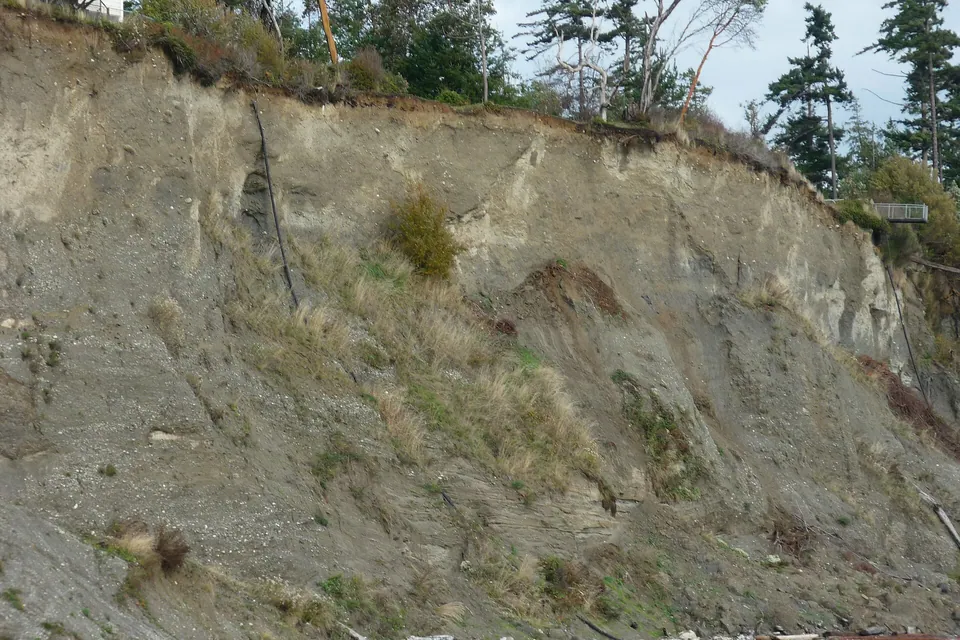
Your city or county planning department is the first stop for a bluff or shoreline question, with a qualified geologist for the site itself; Ecology says to call 911 if life or public safety is threatened.
Revised November 4, 2026
How it changes, sheet by sheet
Start at the city's Permit Center, 360-874-5533, and ask which office reviews shoreline and slope questions.
The Kitsap County Department of Community Development is the county's permit door. For a seeping septic system, Kitsap Public Health takes septic questions at 360-728-2235; its page says shoreline sampling covers Manchester and Southworth and names failing septic systems among the main pollution sources.
Ask the City of Gig Harbor. Its permits page puts work on anything joined to a city stormwater utility under civil permits, so drainage plans may have a second reviewer.
Pierce County Planning and Public Works has jurisdiction on unincorporated land. Tacoma-Pierce County Health Department approves septic systems.
Same county office, with one local extra: Burley Lagoon is a shellfish protection district, and the health department's surface water team is at (253) 649-1420.
Inside Tacoma, ask Planning and Development Services at (253) 591-5030. The Town of Ruston handles its own permits at (253) 759-3544 ext 4.
The same Tacoma office covers land inside the city, and Pierce County takes the unincorporated parts. How much of Dash Point falls in King County is unconfirmed, so give the office your parcel number.
City or town staff first: University Place building permits 253-460-2509, Steilacoom building inspection 253-983-2077, Lakewood permit center 253-512-2261, Federal Way Permit Center (253) 835-2607.
Who decides what you can do on a slope?
Local government decides, under rules that differ from one jurisdiction to the next. Ecology tells owners to check with local planning about setbacks, vegetation, drainage, septic placement and limits on hard surfaces.
Shorelines come under a Shoreline Master Program, which Ecology describes as local land-use policies and regulations covering public and private uses. More than 260 cities and counties have one. This page does not go through any one South Sound program, so it prints no setback distance and no list of permits. Ask the planning office to name the rule that covers your parcel. The permits sheet-by-sheet page lists the local counters.
What does the state say about water near a bluff?
Move it away from the slope, in Ecology's general guidance. Its coastal landslides page says to carry runoff from roofs and other hard surfaces away in a pipe system, to inspect and maintain drainage regularly, and to keep natural drainage patterns unless a qualified geologist or geotechnical engineer says otherwise.
Ecology's 1995 guide for Puget Sound owners and contractors, publication 95-107, adds more. The PDF is an old scan, so check the page images before relying on exact wording. In substance it says:
- Rapid, concentrated runoff flowing onto or into a slope can seriously affect stability and erosion.
- Drywells that let water soak into soil near a slope are not recommended.
- A trench close to the top of the bluff could cause failure instead of preventing it.
- Recontouring a slope should only happen with a geotechnical engineer guiding it.
Treat these as reasons to call someone. This atlas gives no drain, grading or bulkhead instructions. We found no state sentence saying in so many words not to dump water on a bluff; the lines above come closest. We also could not reach Ecology's separate web page on managing drainage on coastal bluffs. For gutters and downspouts away from the edge, see wet winter water around the house.
Septic, sprinklers and the bluff edge
Ecology says to avoid placing septic drain fields or irrigation systems between your home and the bluff edge, and warns that a drain field there can worsen slope instability. Publication 95-107's checklist sends a septic system seeping onto a slope to the local planning office, among others, and lists the health department, a geotechnical engineer and a civil engineer specializing in drainage as resources.
Waterfront also changes one Pierce County septic rule. The health department's March 20, 2025 bulletin lists "not on waterfront" among the conditions for moving from a three-year to a five-year inspection cycle. More is on the peninsula septic page. Sprinkler lines carry their own rules, covered under backflow and irrigation.
Who to call, in what order
- Ground moving, or anyone at risk: 911.
- A slide with no immediate danger, or a worry: local planning and a qualified geologist, as Ecology advises.
- Septic seeping toward a slope: the county health agency for your sheet, plus planning.
- Any digging at all, once a professional has signed off: 811 first.
Keep people away from both the top and the foot of a slope that is moving. Don't walk out onto a cracked or slumping edge to inspect it; a geologist can do the looking.
Check your own address
- Ask your planning office in writing whether the parcel lies in shoreline jurisdiction and which slope rule applies to it.
- In Pierce County, ask the health department for the septic as-built; the county's records page says that department holds them, and it shows where the drain field sits.
- Ask Kitsap Public Health what records it has for a septic system on a Kitsap shore lot.
- Note where each downspout and sprinkler line ends, viewed from a safe distance, and bring that note to the geologist.
Source notes
- Coastal landslides and bluff stability, Washington Department of Ecology. Checked November 4, 2026.
- Shoreline Master Programs, Washington Department of Ecology. Checked November 4, 2026.
- Surface Water and Groundwater on Coastal Bluffs, publication 95-107 record. Checked November 4, 2026.
- Surface Water and Groundwater on Coastal Bluffs, publication 95-107 PDF. Checked November 4, 2026.
- Shore Friendly Living: Coastal Beaches and Bluffs, Washington Department of Fish and Wildlife. Checked November 4, 2026.
- On-site program bulletin of March 20, 2025, Tacoma-Pierce County Health Department. Checked November 4, 2026.
- Wastewater resources, City of Tacoma. Checked November 4, 2026.
- Sanitary and storm sewer, Town of Ruston. Checked November 4, 2026.
- Permit Center, City of Federal Way. Checked November 4, 2026.
- Permit Center, City of Port Orchard. Seen only as a search summary on November 4, 2026; confirm on the page.
- Prepare, apply and manage permits, Kitsap County. Seen only as a search summary on November 4, 2026; confirm on the page.
- Septic programs, Kitsap Public Health District. Seen only as a search summary on November 4, 2026; confirm on the page.
- Pollution identification and correction, Kitsap Public Health District. Seen only as a search summary on November 4, 2026; confirm on the page.
- Permits, City of Gig Harbor. Seen only as a search summary on November 4, 2026; confirm on the page.
- Residential permits, Pierce County. Seen only as a search summary on November 4, 2026; confirm on the page.
- Sewer, Pierce County. Seen only as a search summary on November 4, 2026; confirm on the page.
- Public records, Pierce County. Seen only as a search summary on November 4, 2026; confirm on the page.
- Safe shellfish, Tacoma-Pierce County Health Department. Seen only as a search summary on November 4, 2026; confirm on the page.
- Who to call, City of University Place. Seen only as a search summary on November 4, 2026; confirm on the page.
- Steilacoom utility services, Town of Steilacoom. Seen only as a search summary on November 4, 2026; confirm on the page.
- Customer service, Lakewood Water District. Seen only as a search summary on November 4, 2026; confirm on the page.